

Why Breathing Is the Foundation (That Most Programs Miss)
If you’ve been around here for a while, you’ve probably heard me say it a hundred times:
Everything comes back to breath.
And it’s not just something I teach. It’s something I’ve lived.
When I first started working through my pelvic floor symptoms, I thought I needed to do more. More pelvic floor exercises. More core work. More glute bridges. But nothing actually changed until I changed how I was breathing.
The Pelvic Floor and Diaphragm Work as a Team
Your pelvic floor is not working alone. It’s directly connected to your diaphragm.
Think of your diaphragm like:
- A dome
- An umbrella
- Or even a plunger
When you inhale, that diaphragm descends and expands in 360 degrees. Just like a plunger pressing down and expanding outward.
- Pushes into your ribcage
- Expands your abdominal wall
- Gently moves your abdominal and pelvic organs downward
And in response? Your pelvic floor reflexively lengthens like a trampoline lowering.
What Happens When You Exhale
Now the opposite happens. When you exhale:
- The diaphragm rises back up into a dome
- Pressure moves upward
- Your abdominal wall recoils
And your pelvic floor? It lifts and recoils. That trampoline comes back up. This inhale + exhale pattern is what allows your pelvic floor to:
- Lengthen
- Lift
- Respond to movement
This is also why doing isolated strengthening — like what I break down in why kegels aren’t the fix you’ve been promised — often misses the bigger picture.
Why Breathing Is the Key to Core Strength
Here’s the part most people miss: Your deep core muscles are breathing muscles.
So if your breathing isn’t working… Your core isn’t working. And if your diaphragm is the “driver” of this system, that means your breath is what creates movement and connection in your pelvic floor. Without it:
- You can’t properly lengthen the pelvic floor
- You can’t properly lift it
- You can’t coordinate strength
The “Stack” That Changes Everything
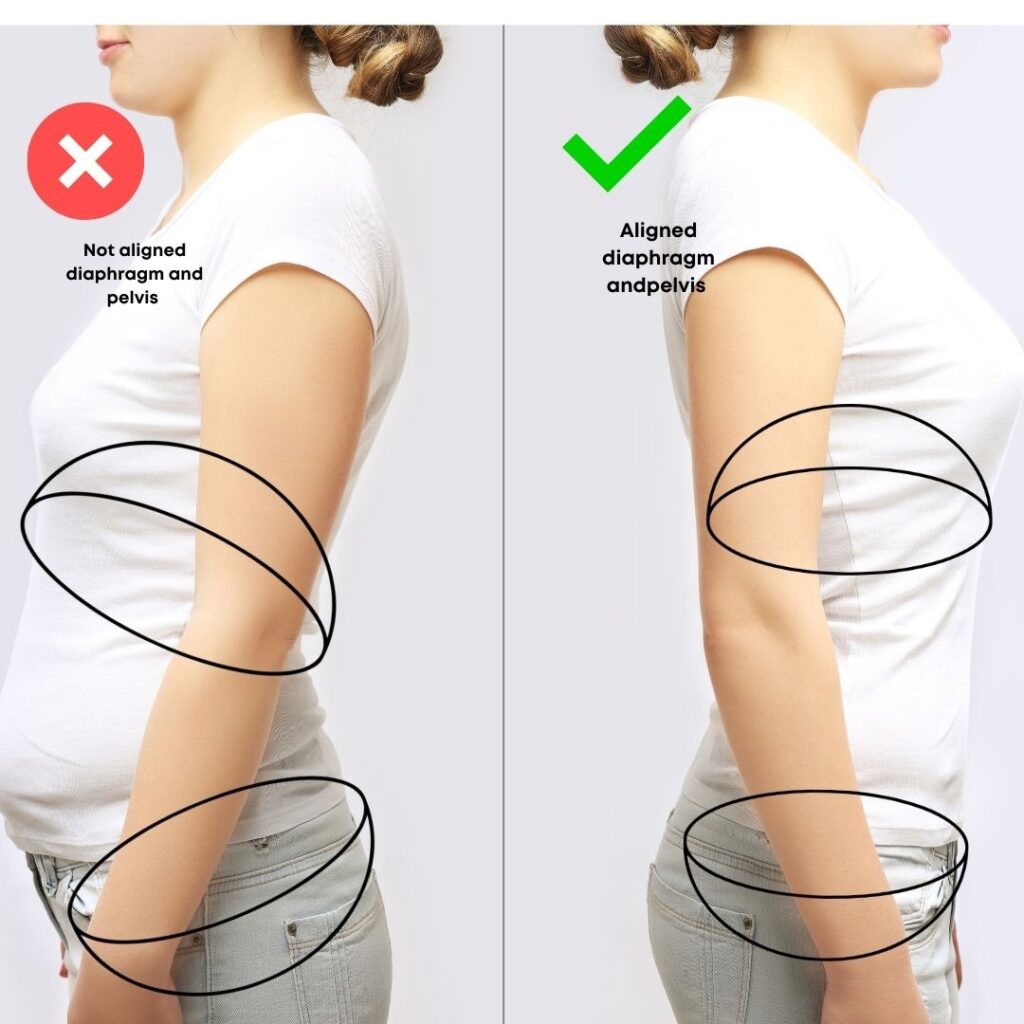
If breath drives the system, then position determines how well it works. This is where the concept of the “stack” comes in.
Think of:
- Your diaphragm (top bowl)
- Your pelvic floor (bottom bowl)
Stacked directly on top of each other.
When they’re aligned:
- Pressure distributes evenly
- The system works as a whole
- Your core and pelvic floor can function optimally
What Happens When You’re Not Stacked
Now let’s look at what happens when that alignment is off. For example: An anterior pelvic tilt (pelvis pushed forward) + flared ribs creates what’s called a “scissor position.” In this position:
- The back of your diaphragm and pelvic floor don’t connect well
- Pressure gets pushed forward instead of evenly distributed
So instead of pressure being shared across your system, it all goes into the front of your body.
Why This Makes Symptoms Worse
If you already have:
- Diastasis recti
- Core weakness
- Pelvic floor dysfunction
- Prolapse symptoms
This forward pressure strategy makes it worse. Because now you’re:
- Overloading weakened areas
- Reinforcing poor pressure patterns
- Adding stress instead of support
This is also why symptoms can fluctuate based on internal factors like hormones, which I explain more in why pelvic floor symptoms get worse around your cycle.
What Your Body Actually Needs
Instead of doing more exercises, you need to improve how your system works. That starts with:
1. Finding Your Stack
Getting your ribcage aligned over your pelvis so your diaphragm and pelvic floor can work together.
2. Creating Ribcage Mobility
Allowing your ribs to expand so your diaphragm can move properly.
3. Connecting Breath to Your Core
Learning how to use your inhale and exhale to:
- Control pressure
- Lengthen
- Lift
Why Most Core Work Isn’t Fixing Your Symptoms
If you’ve been:
- Doing core workouts consistently
- Trying to strengthen your pelvic floor
- Following programs that “should” work
But still dealing with:
- Leakage
- Pressure
- Weakness
- Lack of control
This is likely the missing piece. Because you’re not lacking effort. You’re lacking coordination in your pressure system.
The Bottom Line
Breathing is not a small detail. It is the foundation of:
- Core strength
- Pelvic floor function
- Pressure management
Your diaphragm and pelvic floor are designed to work together. And when you restore that connection:
- Your core works better
- Your symptoms improve
- Your strength actually translates into real life
Not because you did more, but because you finally trained the system the way it was designed.
Want Help Putting This Into Practice?
This is exactly what I teach inside my programs. Not just exercises, but:
- How to breathe
- How to manage pressure
- How to build strength without increasing symptoms
Leave a Reply



Reclaim your strength today
Stop managing symptoms and start building real solutions with our pelvic floor workouts and exercises for women.
Learn more
HSA/FSA eligible

Yes, I totally agree and I want to do this, but as I said, in my first comment, my schedule is just stacked right now and I don’t think I have time to fit this in. Are there things I can just listen to without having to look at my phone and possibly be multitasking or at least walking while I am learning?
I completely understand Sue! 😊 While the workouts themselves do require you to follow along and be present, many members start by watching the education videos in smaller chunks when they have time. Unfortunately, the program isn’t set up as an audio-only or podcast-style experience.
That said, you don’t have to do everything at once. Many busy members work through the education and workouts at their own pace, even if that means taking longer than the suggested timeline. The program will still be there when you’re ready, and there’s no pressure to rush through it. 💛
I like this
Thank you